
Why does my hot tub breaker keep tripping?
If you are reading this, your breaker probably goes all the way off, you switch it back on, and it trips again. That is the sign of a tub that will not reset, and the first thing most owners want to know is what is causing it.
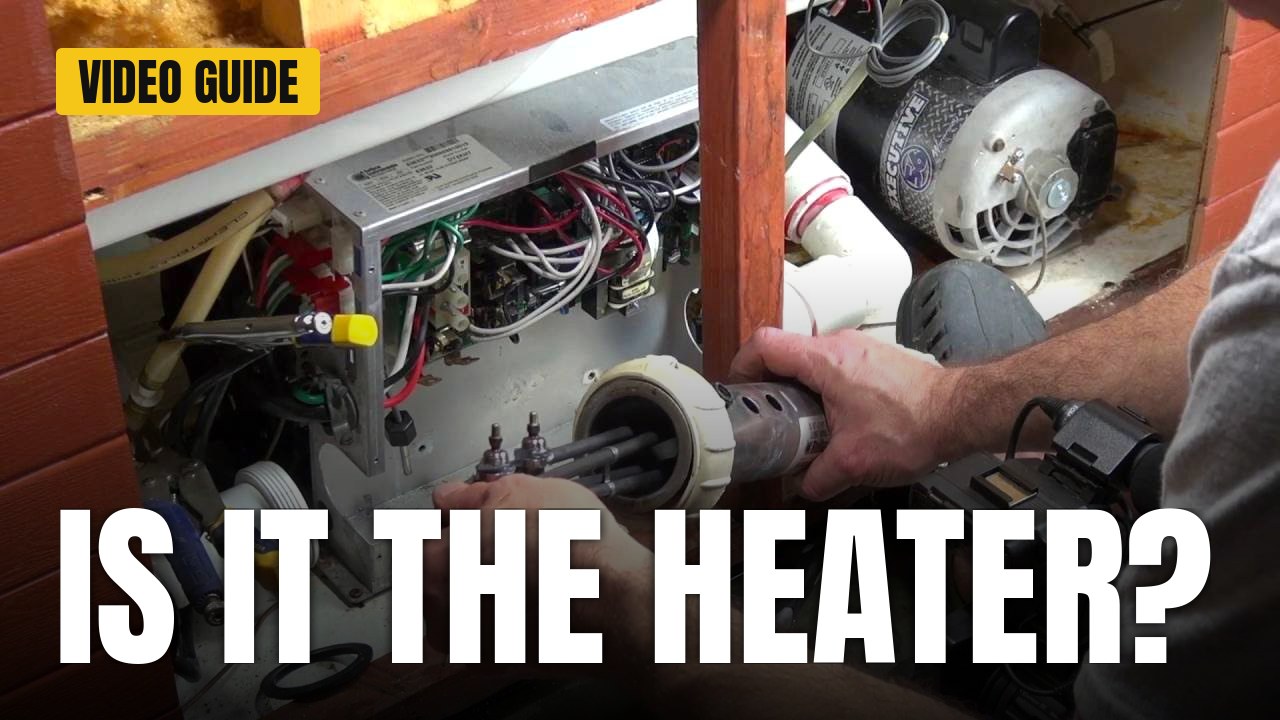
The Spa Guy suspected the heater in the tub he used for this video, but he says plainly that he did not know it for a fact. So he walks through a simple order of tests to find out, and he says the process is similar on all brands.
The questions owners ask, answered one by one
Where do I start? Unplug the extras first. If the tub has a blower, unplug it from the board and try to reset the breaker. Then unplug the ozonator, if there is one. It is a small ozone device plugged in on the side of the pack, and it is usually labeled. Then unplug the circulation pump and each jet pump. Mark every plug so each one goes back where it came from. In the video the breaker still tripped, so none of those were the cause.
How do I test the heater? Take it out of the circuit. With the power off, use wrenches to undo the nuts and pull the wire tabs off the heater. Hold the bottom nut with one wrench while you loosen the top nut with another. It was a 1/4 inch on the bottom of this one, and he says some are 3/8. Holding the bottom nut keeps you from twisting off an electrode on a heater that might be fine. Then try the breaker. If it sets and the pumps come on, the heater is bad. In the video it did, and he reconnected a wire to show it trips the breaker immediately. He says he does not recommend you do that part yourself.
What are the signs of a bad heater? In his tub there was rust around the edge of one electrode. He explains that water leaks up from the bottom, gets through the epoxy on the inside and causes problems. When he pulled the old element, rust was visible there again.
Be careful. Once the tub is powered up there is 115 volts on each leg of the heater, and it can shock you.
What if the breaker still will not set with the heater disconnected? Then it is plan B. Miswired or touching wires can cause it. If the tub has run at your house for a year or more, he says a GFI or wiring problem is not likely. If you just wired the tub up and it will not set, the GFI could be wired wrong or something could be hooked up wrong. If you cannot find it in normal diagnosis, it is probably something man-made, such as a plug in the wrong place or a pinched wire in a collet. These usually leave a burn mark.
Is it the transformer? He says no. He services about 7,000 tubs and has never seen a bad transformer on a Balboa or a Gecko. He has seen one bad on a Sundance, one time. His view is that it is so rare it is not worth talking about.
How do I swap the heater without draining the tub? Close the slice valves (service valves) on either side of the heater. Each has a keeper you remove, then you push the valve in and twist it. Pinch the bleeder hose on the front of the pump with needle-nose vise grips, and he found that pinching at an angle stops water better. He warns that the valves may not hold, especially on older tubs. If water gushes when you loosen a nut, look for an air bleeder. If there is none, the valves are probably not going to hold. In his case they did not, so he lowered the water.
What should I do when installing the new element? Pull the sensors out of the tube (this tub uses M7 sensors, and he leaves them plugged into the board). Take the old element out and look inside the tube. Clean the rust off with a wire brush. Check that the O-rings are in place, and put a little silicone around the threads by the O-ring. Slide the element in and hold a finger inside to keep it off the tube wall while you tighten. The element must not touch the inside of the tube, because that creates a hot spot. Back the nuts off a little to center it, then snug everything down. Do not fully tighten the tube until the bands are on.
Which heater did he use? He uses titanium instead of the standard Incoloy style. He says titanium is resistant to salt and other things, though not impervious. He also notes that chlorine is a salt derivative and most sanitizers are based on salt.
What about the gasket? If it has been a while, he says replacing it is not a bad idea, because chemicals will eat gaskets up. If a gasket splits when you disturb it, you are done until you get a new one.
How do I know the new heater is good? Check across the heater with a meter in the ohms setting. On this 5.5 kW heater he read about 10.5 to 10.6, which is good. A 4 kW heater will read higher, around 15.5. When the tub fires, he saw about 20 amps on the 5.5 kW and says a 4 kW is roughly 15 and a half. The heater tube should feel the same temperature as the tub water. If it is hotter, something is wrong.
What if I get a flow code after the swap? On this M7 system, the tub does a test fire of about 8 seconds and looks for about a 3 degree rise between the two sensors. If it does not see it, it thinks there is not enough water movement and gives a flow code. His tub gave one, because air was trapped. He unplugged the pump for a moment, then loosened a nut to let the air out, and the pump started moving water. This varies by brand, since a pressure switch or Gecko system does not do the same test.
Who is answering these questions?
SpaPartsNet is owned and run by The Spa Guy team, the same people who make these videos. The man in the video is the one running the store, and the advice here comes from his own hands-on work.
What you get from testing it this way
- You find out whether the heater is the problem before you buy anything.
- Unplugging the blower, ozonator and pumps one at a time rules out the easy suspects.
- You can skip a transformer you probably do not need.
- A cleaned tube, silicone on the O-rings and a centered element give the new heater a proper install.
- Meter readings and a test fire let you confirm the repair worked.
- You know what a flow code after the swap usually means, and how to bleed the air out.
Get the right part and watch the full video
If your test points to a bad heater, shop SpaPartsNet for the heater element and the gasket you need. In the video, The Spa Guy says the store carries heaters, pressure switches and other parts for your hot tub.
Watch the full video first if you want to see each test and the swap done step by step. Then come back and find what you need.